



Note: Please check your Spam or Junk folder, in case you didn't receive the email with verification code.

 English
Non-Linear: Random Order
At the end of this program
You will be able to
At the end of this program
Learners will be able to define Data Analytics and articulate its importance in various industries.
Learners will be able to outline and explain the key phases of the Data Analytics process, including data collection, cleaning, exploration, analysis, and visualization.
Learners will demonstrate an understanding of how data-driven decision-making is applied in real-world scenarios.
Learners will be able to identify and describe the responsibilities and skill sets required for various data-centric roles.
Learners will be able to compare and contrast the focus areas and tools used by Data Engineers, Data Analysts, Data Scientists, Business Analysts, and BI Analysts.
Learners will be able to determine which data role aligns best with specific business or organizational needs.
Learners will demonstrate the ability to collect data from diverse sources for analysis.
Learners will be able to perform data wrangling tasks such as cleaning, transforming, and organizing datasets.
Learners will gain foundational knowledge in data mining techniques to uncover patterns and trends and use visualization tools to represent data insights effectively through charts, dashboards, and reports.
.
 Concept of Data Analytics
Role of a Data Analyst
Classification of Data Structured, Semi-Structured, Unstructured
Scale of Measurement of Data
Various Data Sources and Modern Data Collection Methods
Concept of Data Analytics
Role of a Data Analyst
Classification of Data Structured, Semi-Structured, Unstructured
Scale of Measurement of Data
Various Data Sources and Modern Data Collection Methods
 Unit1 Test
15 Questions
Unit1 Test
15 Questions
 For Reference: What is Data Analytics
Duration:
Data Presentation and Visualization
Types of Diagrams in Data Visualization
Descriptive Statistics
Univariate, Bivariate, and Multivariate Analysis
Unit2 Test
15 Questions
Ref:Data Visualization
Duration:
Overview of SPSS Menus and Interface
Creating and Managing Data Files in SPSS
Importing and Exporting Files in SPSS (Excel, CSV, etc.)
Variables and Labels in SPSS
Selecting Cases, Filtering, Recoding Data, and Merging Files in SPSS
Unit3
15 Questions
Ref: Data Analysis
Duration:
Data Visualization using Frequency Tables and Charts
Descriptive Statistics and Cross-Tabulations
Compare-Means, ANOVA, Independent Sample t-Test, Paired Sample t-Test, One-Way ANOVA, and Chi-Square Tests
Simple and Partial Correlation
General Linear Model (GLM)
Unit4
15 Questions
Exploratory Data Analysis
Duration:
R Installation, Loading, and Using Packages
Data Types and Structures in R Vectors, Matrices, Lists, Factors, and Data Frames
Conditional Statements, Loops, Functions, and Apply Family in R
Data Import in R CSV Files, Web Data, and Excel Files
Handling Missing Values and Outliers in R
Descriptive Statistics and Data Visualization in R
Linear Regression Using R.
Unit5 Test
15 Questions
Reference: Hypothesis testing
Duration:
Installation of Python Software
Keywords, Identifiers, Comments, Indentation, and Statements in Python
Data Structures and Types in Python
String Operations in Python
Input-Output Handling and Formatting in Python
Operators and Control Flow in Python
Functions in Python
Unit6
20 Questions
ANOVA- I
Duration:
Introduction to Data Science using Python
NumPy and Pandas for Data Manipulation
Data Visualization in Python
Exploratory Data Analysis (EDA) using Python
Unit7
15 Questions
Reference : Randomize block design
Duration:
Identifying an Industry or Business Problem
Collecting and Analyzing Data
Developing a Data-Driven Solution
Creating a Business Case
Presenting Findings to Industry Leaders and Faculty
Unit8
20 Questions
Reference: Linear Regression - II
Duration:
Final Assessment
10 Questions
For Reference: What is Data Analytics
Duration:
Data Presentation and Visualization
Types of Diagrams in Data Visualization
Descriptive Statistics
Univariate, Bivariate, and Multivariate Analysis
Unit2 Test
15 Questions
Ref:Data Visualization
Duration:
Overview of SPSS Menus and Interface
Creating and Managing Data Files in SPSS
Importing and Exporting Files in SPSS (Excel, CSV, etc.)
Variables and Labels in SPSS
Selecting Cases, Filtering, Recoding Data, and Merging Files in SPSS
Unit3
15 Questions
Ref: Data Analysis
Duration:
Data Visualization using Frequency Tables and Charts
Descriptive Statistics and Cross-Tabulations
Compare-Means, ANOVA, Independent Sample t-Test, Paired Sample t-Test, One-Way ANOVA, and Chi-Square Tests
Simple and Partial Correlation
General Linear Model (GLM)
Unit4
15 Questions
Exploratory Data Analysis
Duration:
R Installation, Loading, and Using Packages
Data Types and Structures in R Vectors, Matrices, Lists, Factors, and Data Frames
Conditional Statements, Loops, Functions, and Apply Family in R
Data Import in R CSV Files, Web Data, and Excel Files
Handling Missing Values and Outliers in R
Descriptive Statistics and Data Visualization in R
Linear Regression Using R.
Unit5 Test
15 Questions
Reference: Hypothesis testing
Duration:
Installation of Python Software
Keywords, Identifiers, Comments, Indentation, and Statements in Python
Data Structures and Types in Python
String Operations in Python
Input-Output Handling and Formatting in Python
Operators and Control Flow in Python
Functions in Python
Unit6
20 Questions
ANOVA- I
Duration:
Introduction to Data Science using Python
NumPy and Pandas for Data Manipulation
Data Visualization in Python
Exploratory Data Analysis (EDA) using Python
Unit7
15 Questions
Reference : Randomize block design
Duration:
Identifying an Industry or Business Problem
Collecting and Analyzing Data
Developing a Data-Driven Solution
Creating a Business Case
Presenting Findings to Industry Leaders and Faculty
Unit8
20 Questions
Reference: Linear Regression - II
Duration:
Final Assessment
10 Questions
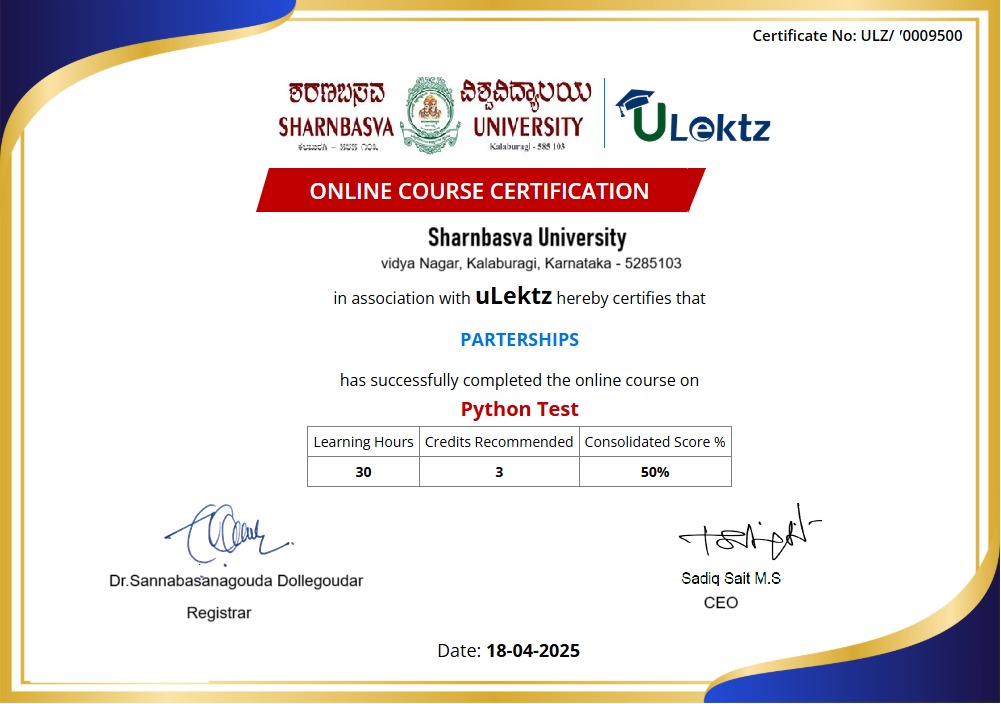
The certificate issued for the Course will have
Only the e-certificate will be made available. No Hard copies. The certificates issued by Sharnbasva University, Kalaburagi. can be e-verifiable at www.ulektzskills.com/verify.

 90 hours Learning Content
 100% online Courses
 English Language
 Certifications
Recommended Courses
See more
 60 hours of Learning Content


60 hours of Learning Content

50 hours of Learning Content

50 hours of Learning Content

40 hours of Learning Content


 0
0




 Course Enrollment