



Note: Please check your Spam or Junk folder, in case you didn't receive the email with verification code.

 English
Non-Linear: Random Order
A Python course aims to:
Equip students with the ability to write efficient and effective Python code.
Introduce fundamental programming concepts and problem-solving techniques.
Develop an understanding of Python's standard libraries and frameworks.
Provide hands-on experience through projects and practical applications.
By the end of the course, students will be able to:
Understand Python syntax and semantics.
Write and debug Python programs.
Utilize Python for data manipulation and analysis.
Implement object-oriented programming concepts in Python.
Use Python libraries for web development, data science, and automation.
The course enhances various skills, including:
Programming Proficiency: Writing clean and efficient code.
Problem-Solving: Developing logical thinking and troubleshooting abilities.
Data Handling: Manipulating and analyzing data using Python libraries.
Web Development: Building web applications with frameworks like Django and Flask.
Automation: Automating tasks and workflows with Python.
Machine Learning: Using Python libraries like TensorFlow and Scikit-learn for AI and machine learning projects.
Knowledge of Python opens up numerous career opportunities, such as:
Software Developer: Building applications and software solutions.
Data Scientist: Analyzing and interpreting complex data sets.
Machine Learning Engineer: Developing and deploying machine learning models.
Web Developer: Creating dynamic and interactive websites.
Automation Engineer: Designing and implementing automated solutions.
DevOps Engineer: Managing and automating infrastructure using Python scripts.
 Overview of Python and its applications
Installing Python and setting up the development
Using Python interactive shell and IDEs
Overview of Python and its applications
Installing Python and setting up the development
Using Python interactive shell and IDEs
 Unit1 Test
10 Questions
Variables and data types
Basic operators and expressions
Input and output operations
Comments and code formatting
Unit2 Test
20 Questions
Conditional statements
Loops
Break, continue, and pass statements
List comprehension
Unit3 Test
10 Questions
Defining and calling functions
Function arguments and return values
Lambda functions
Creating and importing modules
Unit4
10 Questions
Lists and list operations
Tuples and sets
Dictionaries and their methods
Strings and string manipulation
Unit5 Test
10 Questions
Reading from and writing to files
Working with CSV and JSON files
Try-except blocks for error handling
Raising and handling exceptions
Classes and objects
Inheritance and polymorphism
Encapsulation and abstraction
Magic methods and operator overloading
Introduction to pip and package management
Overview of standard library modules
Working with date and time
Regular expressions with re module
Introduction to NumPy for numerical computing
Pandas for data analysis
Basic data visualization with Matplotlib
Introduction to web frameworks
Creating a simple web application
Handling HTTP requests and responses
Writing scripts for system administration tasks
Automating file operations
Web scraping basics with Beautiful Soup
PEP 8 style guide
Code organization and documentation
Performance optimization techniques
Debugging tools and techniques
Basic Git commands
Creating and managing repositories
Collaborating with others using Git
Unit testing with unittest framework
Writing and running test case
Test-driven development concepts
Final Test
20 Questions
Unit1 Test
10 Questions
Variables and data types
Basic operators and expressions
Input and output operations
Comments and code formatting
Unit2 Test
20 Questions
Conditional statements
Loops
Break, continue, and pass statements
List comprehension
Unit3 Test
10 Questions
Defining and calling functions
Function arguments and return values
Lambda functions
Creating and importing modules
Unit4
10 Questions
Lists and list operations
Tuples and sets
Dictionaries and their methods
Strings and string manipulation
Unit5 Test
10 Questions
Reading from and writing to files
Working with CSV and JSON files
Try-except blocks for error handling
Raising and handling exceptions
Classes and objects
Inheritance and polymorphism
Encapsulation and abstraction
Magic methods and operator overloading
Introduction to pip and package management
Overview of standard library modules
Working with date and time
Regular expressions with re module
Introduction to NumPy for numerical computing
Pandas for data analysis
Basic data visualization with Matplotlib
Introduction to web frameworks
Creating a simple web application
Handling HTTP requests and responses
Writing scripts for system administration tasks
Automating file operations
Web scraping basics with Beautiful Soup
PEP 8 style guide
Code organization and documentation
Performance optimization techniques
Debugging tools and techniques
Basic Git commands
Creating and managing repositories
Collaborating with others using Git
Unit testing with unittest framework
Writing and running test case
Test-driven development concepts
Final Test
20 Questions
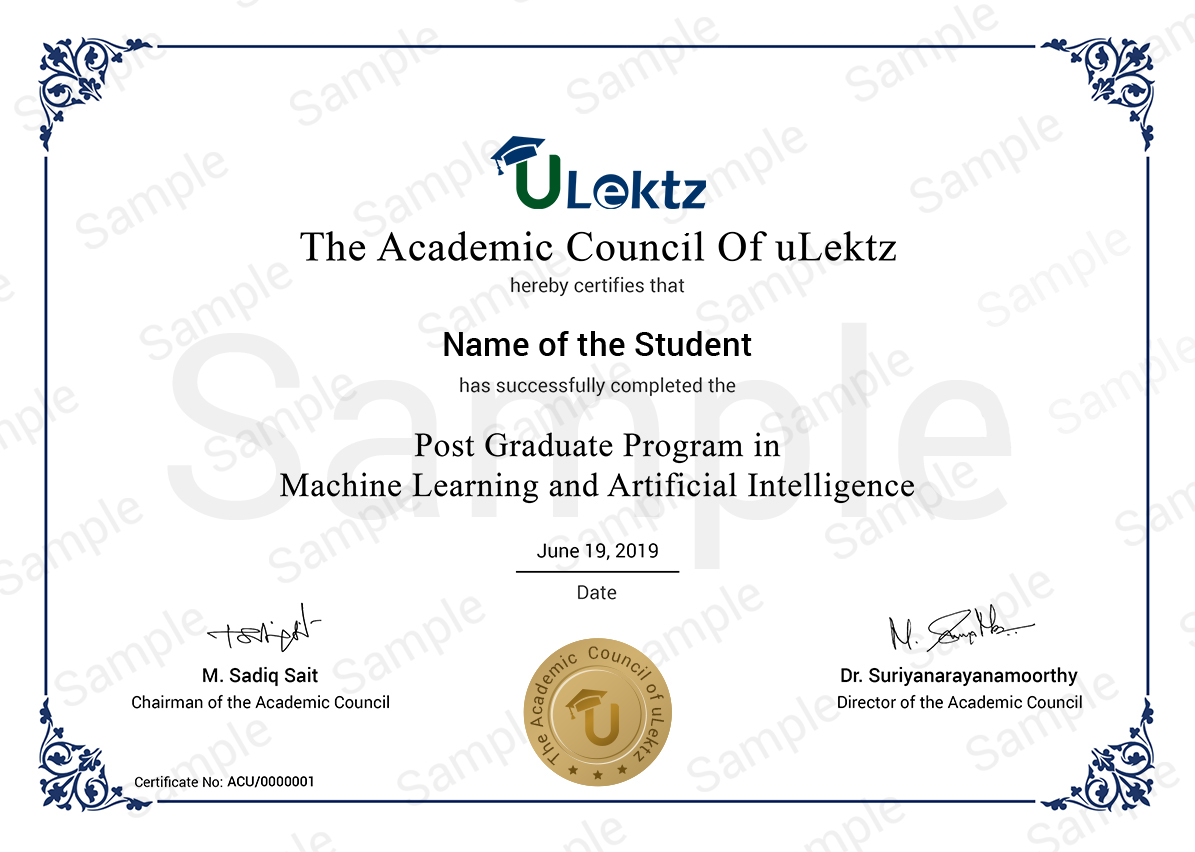
The certificate issued for the Course will have
Only the e-certificate will be made available. No Hard copies. The certificates issued by The Academic Council of uLektz. can be e-verifiable at www.ulektzskills.com/verify.

 40 hours Learning Content
 100% online Courses
 English Language
 Certifications
Recommended Courses
See more
 90 hours of Learning Content


90 hours of Learning Content
180 hours of Learning Content
90 hours of Learning Content
90 hours of Learning Content
90 hours of Learning Content


 0
0

 Course Enrollment